Scalability Engineering Services That Keep You Up When Traffic Jumps
Evolve Edge delivers scalability engineering services for products facing a launch, a traffic spike, or fast growth. We test your system under realistic traffic, fix what breaks first, and give you a capacity plan that shows when to scale and what it will cost.
- Load tests run
- 60+
- Traffic headroom proven before major launches
- 10×
- Weeks typical timeline
- 3–10
- Engineers only
- Senior
What Is Scalability Engineering?
Scalability engineering makes sure a product keeps working as users, traffic, and data grow. It finds the point where your system starts to slow or fail, then removes those limits before real customers hit them. It differs from performance engineering, which focuses on how fast a single request is rather than how the whole system holds up under volume.
Scalability Engineering
How the whole system holds up
Finds the point where your system starts to slow or fail as users, traffic, and data grow, then removes those limits.
Performance Engineering
How fast a single request is
Focuses on the speed of individual requests rather than how the whole system behaves under volume.
See our performance engineering service
Moments That Call For Scalability Engineering
Most teams reach out ahead of a specific moment, when guessing about capacity becomes too risky.
A Product Launch
The date is set, the marketing is booked, and expected traffic is still a guess.
A Sales Event
Black Friday or a major promotion is coming, and last year's numbers no longer apply.
Press Or A Viral Moment
Sudden attention arrives without warning, and you have one chance to stay online.
Fundraising Due Diligence
Investors want evidence that the platform can grow without a costly rebuild first.
A Large New Customer
One enterprise account could double your traffic overnight once its teams log in.
A Recent Outage
Something already broke under pressure, and you need to know why before it repeats.
Our Scalability Engineering Services
Six services cover testing, fixing, and planning for growth. Each is explained further down.
Load Testing
Realistic traffic run against your product to see how it copes.
Stress, Spike, And Soak Testing
Tests that find your breaking point, surge limits, and slow leaks.
Database Scaling
The changes that stop your database from becoming the first limit.
Scaling Weak Points
Queues, busy customers, and outside limits that fail before servers do.
Capacity Planning
A schedule showing when to add capacity and what it will cost.
Launch Readiness Review
A focused check and launch-day support before your highest-stakes moments.
Load Testing Services Built On Real Traffic
Our load testing services copy how real people use your product, not random traffic aimed at one page. That way, results match what will actually happen on the big day.
Results come in a plain-English report with clear numbers that investors, auditors, and enterprise buyers can read without an engineer translating.
Real User Journeys
Sign-up, search, checkout, and other key paths tested together, the way customers use them.
Traffic From Your Data
Test volumes based on your real usage patterns and the growth targets you are planning for.
Safe Test Environments
A staging copy that mirrors production, with live tests only when agreed in advance.
First Bottleneck Found
Every test names what broke first, why it broke, and what will fix it.
Stress, Spike, And Soak Testing Explained
Our stress testing services and application scalability testing use four types of test. Each one shapes traffic differently and answers a different question about your product.
| Test | What It Simulates | Question It Answers | Typical Length |
|---|---|---|---|
| Load test | Expected busy-day traffic | Do we handle a normal peak? | 30–60 minutes |
| Stress test | Traffic rising past the peak | Where is the breaking point? | 1–2 hours |
| Spike test | A sudden surge | Do we survive and recover from a rush? | 10–20 minutes |
| Soak test | Steady traffic for hours | Does anything slowly leak or wear out? | 8–24 hours |
Database Scaling Before The Database Becomes The Limit
The database is usually the first thing to struggle as traffic grows. Our database scaling work moves from the simplest fixes to the most involved, so you never take on more complexity than you need.
Connection Management
Pooling that stops the database running out of connections under heavy load.
Read Replicas
Extra copies of the database that share the work of answering reads.
Partitioning And Sharding
Large data split up, so no single database has to carry everything.
Archiving Old Data
Rarely used records moved out of the busy path to keep it fast.
For slow individual queries and caching, see Performance Engineering.
Scaling The Parts That Usually Break
Servers are rarely the first thing to fail. These four weak points cause most of the outages we see during growth.
For designing a backend that scales from the start, see Backend Systems.
Background Jobs And Queues
Emails, reports, and imports that pile up under load and delay everything behind them.
Noisy Customers
One large customer whose heavy use slows the product down for everyone else sharing it.
Third-Party Limits
Payment, email, and other providers that cap how many requests you can send per minute.
Autoscaling Settings
Rules for adding servers tuned to your real traffic patterns, not left on default numbers.
Scaling AI Agents And Voice AI
AI products scale differently, because every request depends on an outside model and adds to your bill. We plan for four pressures that ordinary apps never face.
Model Provider Limits
Request caps from AI providers handled with queues and backup models that step in.
Concurrent Voice Calls
Many simultaneous calls handled without delays, dropped audio, or awkward pauses.
Long-Running AI Tasks
Multi-step agent work processed reliably in the background, even when volume jumps.
AI Cost Per Conversation
Spending per conversation tracked, so growth never quietly outpaces your margins.
For GPU capacity and private model hosting, see the AI infrastructure section of our Cloud and DevOps page.
Capacity Planning Services That Show When To Scale
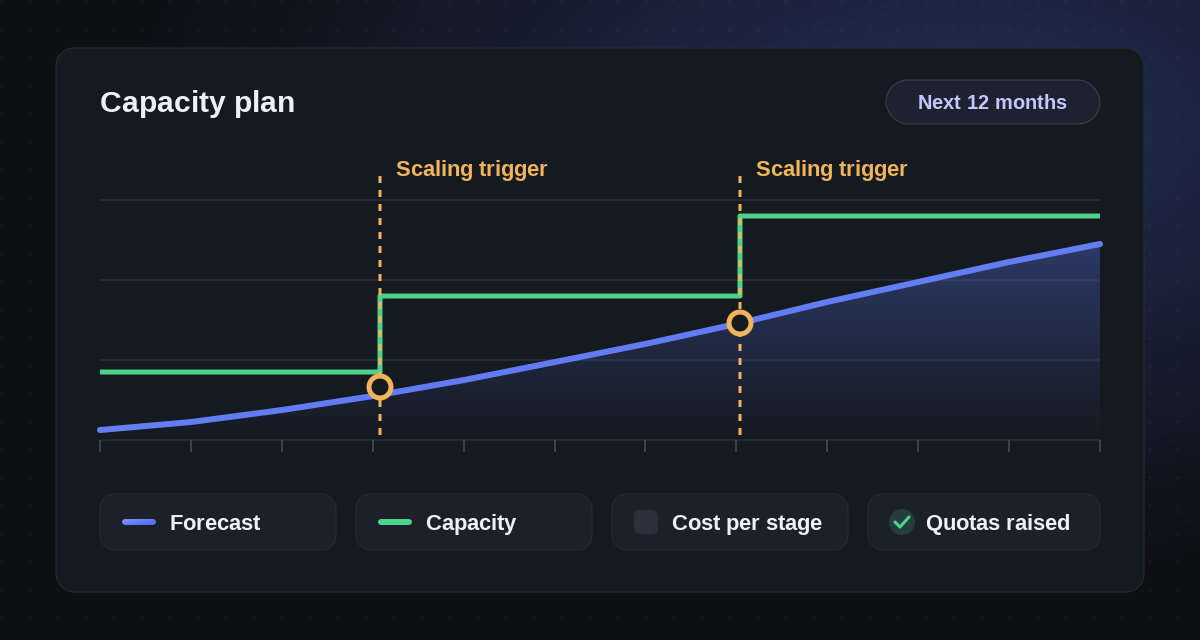
Capacity planning services turn test results and growth forecasts into a clear schedule. You know what to add, when to add it, and what it will cost.
Growth Forecast
Expected traffic and data volumes for the next twelve months, month by month.
Scaling Triggers
The exact points where you will need more capacity, set as alerts.
Cost Projection
What each stage of growth will cost to run, before you commit.
Quota Checks
Cloud and provider limits raised early, so they never block a launch.
Launch Readiness Review For High-Stakes Days
A launch readiness review is a fixed-scope check before a launch, sale, or big announcement. It covers the whole event in three stages.
Before Launch
Capacity, failure plans, rollback options, monitoring, and on-call cover checked against a proven readiness checklist.
Launch Day
Senior engineers on hand with live dashboards, ready to act the moment traffic behaves unexpectedly.
After Launch
A review comparing forecasts with real traffic, plus clear fixes to make the next launch smoother.
How A Scalability Engagement Works
Most engagements run 3 to 10 weeks, from first measurement to a plan you can grow with.
- 1Week 1
Set Targets
We measure how the system behaves today and agree the traffic it must handle.
- 2Weeks 2–4
Test
Tests run in stages from normal traffic up to your target, logging every weak point.
- 3Weeks 4–7
Fix And Retest
Fixes are made, then tests repeated until your system meets every agreed target.
- 4Weeks 7+
Plan Ahead
The capacity plan and step-by-step scaling runbooks are handed over to your team.
Scalability Testing Tools We Use
We use proven open tools, plus the monitoring you already run, to measure every test.
Load Generation
Data
Scaling
Monitoring
Ways To Work With Us
Start with one high-stakes date, or bring us in as you grow.
Launch Readiness Review
The fastest way to start, scoped around one specific launch or event date.
Scalability Project
Full testing, fixing, and capacity planning delivered over three to ten weeks.
Quarterly Capacity Reviews
Regular check-ins that update tests and forecasts as your product keeps growing.
Embedded Engineers
Senior engineers working inside your team for at least 90 days at a time.
How To Choose A Scalability Partner
Before trusting someone with your biggest day, check for these five things.
Partner checklist
- Agreed targetsPass and fail numbers set before any test runs.
- Fixes includedProblems solved, not just listed in a report.
- Relevant experienceLaunches and traffic patterns similar to yours.
- Senior engineersExperienced people running tests and making fixes.
- Honest diagnosisWilling to say when scaling isn't the real problem.
What Affects Scalability Engineering Cost
Every engagement is estimated after a scoping call. These six factors shape your estimate more than anything else.
User Journeys
More paths to test means more scripts to build and run.
Target Traffic
Higher targets need larger tests and more testing infrastructure.
Fixes Needed
The number and depth of fixes uncovered during testing.
Test Environments
Building a production-like environment adds setup time if none exists.
AI And Voice Parts
AI models and voice calls add their own tests and limits.
One-Off Or Ongoing
Reviews and projects get fixed estimates; quarterly reviews use set rates.
Book a scoping call to receive an estimate based on your actual setup.
Book A Scoping CallFrequently Asked Questions
What engineering leaders ask before trusting us with their biggest day.
How do your scalability engineering services start?
With a short scoping call. If a big date is close, we begin with a launch readiness review. Otherwise, we move straight into measuring and testing.
Can you load test production?
We prefer a staging copy of production. When live testing is needed, we run it off-peak, with gradual traffic and the ability to stop instantly.
We don't know our traffic yet. Can you still help?
Yes. We model expected traffic from similar products and your sign-up funnel, then confirm the numbers against real traffic once you launch.
Will testing affect our cloud bill?
Briefly, yes. We estimate the extra cost before testing begins, and every temporary test environment is shut down as soon as testing ends.
Can load tests run automatically in our pipeline?
Yes. Smaller tests can run on every release to catch slowdowns early, with full-scale tests saved for the weeks before big events. See our DevOps consulting services.
How do you test services we don't control?
We replace outside providers with realistic stand-ins during tests, or coordinate test windows with them directly when their limits matter.
Does application scalability testing cover mobile apps and APIs?
Yes. We test web apps, mobile app backends, and public or internal APIs, since each one can hit its limits in different ways.
Who owns the test scripts and results?
You do. Every script, report, and dashboard is handed over, so your team can rerun the same tests whenever things change.
Know Your Breaking Point Before Your Customers Do
Our scalability engineering services start with a free 30-minute scoping call. A senior engineer, not a salesperson, reviews your setup and replies within one business day with a clear next step.
You own every test script, report, and dashboard we create.