DevOps Consulting Services That Make Every Release Routine
Evolve Edge provides DevOps consulting services for teams whose releases are slow, risky, or stuck waiting on one engineer.
- Pipelines in production
- 45+
- Average deploy time
- 12 min
- Weeks typical timeline
- 4–12
- Engineers only
- Senior
What Is DevOps Consulting?
DevOps consulting helps teams ship software faster and more safely by improving how code is built, tested, released, and recovered. It covers three kinds of work: strategy, which decides what to fix first; technical work, which builds pipelines and automation; and operational work, which shapes ownership, habits, and on-call.
We build the pipelines, automation, and security checks that let you ship daily, recover from problems in minutes, and keep improving after we leave. It is one part of our wider cloud and DevOps services.
- 01
Strategy
What to fix first
Delivery measured, bottlenecks found, and a ranked plan agreed before any tools change.
- 02
Technical
Pipelines and automation
Build, test, and release automated so every change follows the same safe path.
- 03
Operational
Ownership and habits
Clear owners, on-call routines, and runbooks so your team keeps improving after we leave.
Signs Your Delivery Process Is Slowing You Down
Delivery problems rarely announce themselves. They show up as small delays that quietly cost your team days every month.
Builds Take Forever
Engineers wait half an hour or more for every check, then lose focus while they wait.
Releases Wait For A Schedule
Finished changes pile up for a weekly release day, so customers wait for fixes that are ready.
Manual Steps Everywhere
Releases depend on checklists, copy-paste commands, and one careful person following them exactly.
Tests Nobody Trusts
Random test failures get ignored, so real problems slip through with everything else.
Environments Drift Apart
Code that works in testing breaks in production, because the two setups no longer match.
Security Finds Issues Late
Vulnerabilities surface after release, when fixing them costs the most time and trust.
Four Numbers That Show Whether DevOps Is Working
The industry measures delivery with four standard metrics, known as DORA metrics. They turn vague feelings about speed and stability into numbers you can track.
Deployment Frequency
How often your team releases changes to real users each week or month.
Lead Time For Changes
How long a finished change takes to travel from code to production.
Change Failure Rate
The share of releases that cause a problem and need a fix.
Time To Restore
How quickly service returns to normal after something goes wrong in production.
Our DevOps Consulting Services
Start with one service or combine several. Each is explained in more detail further down this page.
DevOps Maturity Assessment
A clear picture of where you stand and what to fix first.
CI/CD Pipelines
Automated build, test, and release for every change your team makes.
DevOps Automation
The repetitive tasks around development and release, handled by machines instead.
GitOps Delivery
Production changes made only through requests your team reviews and approves.
DevSecOps
Security checks running inside delivery, not waiting at the very end.
Platform Engineering
Self-service tools that let developers ship without waiting on anyone.
Start With A DevOps Maturity Assessment
A DevOps maturity assessment is a short, fixed-scope review that replaces guesswork with data. In one to two weeks, you learn exactly where delivery slows down and what to change first.
Maturity Scorecard
A simple rating for each area, so you see strengths and gaps at a glance.
Baseline Numbers
Your starting scores for all four delivery metrics, measured from real activity.
Ranked Findings
Every issue we find, sorted by how much it slows delivery or raises risk.
90-Day Roadmap
A practical plan showing what to fix, in which order, and what it will change.
CI/CD Pipeline Services Built For Safe, Frequent Releases
Our CI/CD pipeline services turn every change into a predictable journey: build, test, check, release, and verify.
- 1Build
- 2Test
- 3Check
- 4Release
- 5Verify
Fast checks run on every change, broader tests run before release, and nothing reaches production without passing both. How a release goes live matters just as much.
Gradual Rollouts
New versions reach a small share of users first, then expand once they prove stable.
Feature Flags
Finished code ships switched off, and features turn on when the business is ready.
Parallel Versions
The new version runs beside the old one, and traffic moves across only when it is healthy.
Approval Rules
Changes flow to testing automatically, while production releases can require a named person's sign-off.
DevOps Automation That Removes Manual Work
DevOps automation goes beyond the pipeline itself. It takes over the small, repeated jobs that quietly eat hours of engineering time every week.
For servers and networks defined in code, see Cloud Infrastructure.
Preview Environments
Every change gets its own temporary copy of the app, so reviewers can test it live.
Secrets And Settings
Passwords and configuration managed automatically, never stored in code or shared spreadsheets.
Dependency Updates
Library upgrades proposed, tested, and ready to merge without anyone remembering to check.
Release Notes
Clear changelogs written automatically from merged work, ready to share with customers.
GitOps: Production Changes You Can Review And Undo
With GitOps, production always matches what your team has approved in its code repository. Tools like ArgoCD or Flux keep the two in sync, so nothing changes without a record.
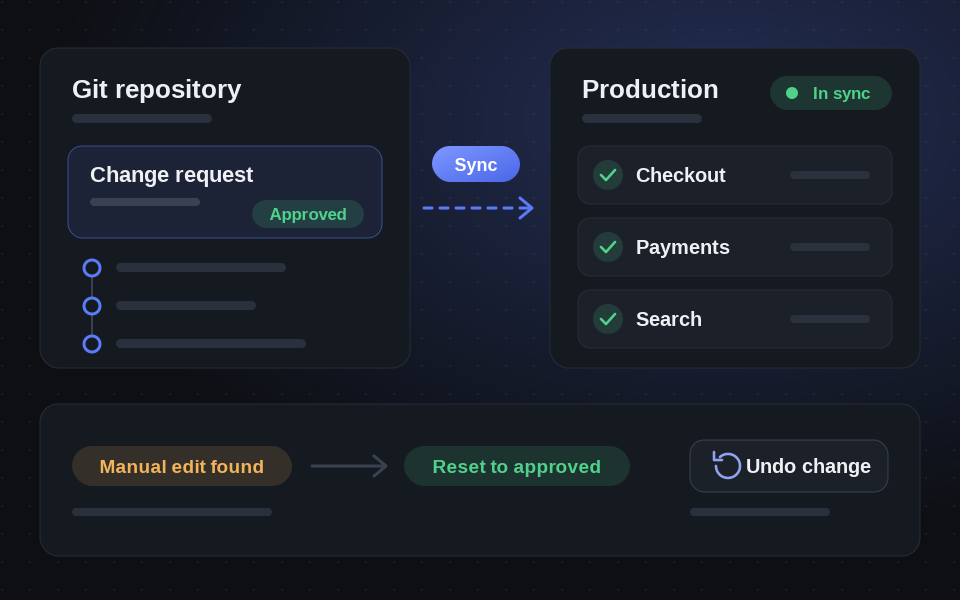
Reviewed Changes
Every production change goes through a request that a teammate checks and approves.
Easy Rollback
Undoing a bad release is as simple as undoing one change in the repository.
Full History
A complete record shows who changed what and when, ready for any review.
No Drift
Manual edits made directly in production are spotted and reversed automatically.
DevSecOps Services That Catch Issues Before Release
DevSecOps is DevOps with security built into every step instead of added at the end. Our DevSecOps services run these four checks automatically on every change your team makes.
Code Scanning
Common security mistakes flagged the moment new code is written.
Dependency Checks
Libraries with known vulnerabilities blocked before they enter the product.
Container Scanning
Application images inspected for risks before they reach production.
Secret Detection
Passwords and keys caught before they can leak into code.
For teams under SOC 2, HIPAA, or PCI, compliance rules run as automated checks and collect audit evidence as you work. For deeper controls, see Security Engineering and our Compliance Pack.
Platform Engineering For Self-Service Delivery
Platform engineering gives developers an internal toolkit to create, test, and release services without filing tickets. It usually pays off once several teams share the same infrastructure and start waiting on each other.
Ready-Made Templates
New services start with pipelines, monitoring, and security already set up correctly.
Self-Service Environments
Developers create their own test environments in minutes, without waiting for help.
Developer Portal
One place to find documentation, service owners, and the health of every system.
Guardrails
Sensible defaults that keep every team safe and consistent without slowing anyone.
DevOps For AI‑Powered Products
AI features change in ways ordinary code does not. A new prompt or model can quietly make answers worse, slower, or more expensive, so delivery needs extra safeguards.
To build the AI features themselves, see AI Agent Development and LLM Integrations.
AI Quality Gates
A test set of real tasks blocks any release that makes answers worse.
Prompt And Model Versioning
Every prompt and model change is tracked, compared, and reversible at any time.
Cost Checks
Releases are flagged automatically when they raise AI spending per request.
Shadow Testing
New models answer real requests silently, and results are compared before switching over.
Our DevOps Consulting Process
Most engagements run 4 to 12 weeks. We prove the approach on one service before changing everything else.
- 1Week 1
Map The Current Flow
We follow real changes from code to production and note every delay, manual step, and failure point.
- 2Weeks 2–4
First Pipeline
One service moves through the new pipeline end to end, with every stage working and documented.
- 3Weeks 4–8
Roll Out
Remaining services move over in batches, and testing and production environments are brought into line.
- 4Weeks 8+
Hand Over
Runbooks, on-call training, and templates go to your team, with a final comparison against the starting numbers.
See our observability service
DevOps Tools We Work With
We build on the tools you already use where possible, and add new ones only when they clearly help.
CI/CD
GitOps
Containers
Infrastructure As Code
Secrets
Clouds
Ways To Work With Our DevOps Team
Start small with an assessment, or bring us in for the whole journey. Choose what fits.
Maturity Assessment
The lowest-risk way to start: fixed scope, a short timeline, and no ongoing commitment.
Pipeline Project
A defined build or overhaul with agreed milestones, an estimate, and a full handover.
Embedded Engineers
Senior DevOps engineers working inside your team for at least 90 days, then handing over.
Managed DevOps
Ongoing pipeline care, release support, and on-call help on a simple monthly retainer.
How To Choose A DevOps Consulting Partner
A good DevOps partner leaves your team stronger, not dependent. Check for these five things.
Partner checklist
- Before-and-after numbersDelivery metrics measured at the start and the end.
- Teaching built inYour engineers learn the system, not just receive it.
- Security from the startChecks inside delivery, not added afterwards.
- Senior engineersExperienced people doing the hands-on work.
- A written planScope, milestones, and estimate agreed before work begins.
What Affects DevOps Consulting Cost
Every engagement is estimated after a scoping call. These six factors shape your estimate more than anything else.
Services And Repositories
More services and code repositories mean more pipelines to build.
Starting Maturity
Teams starting from manual releases need more groundwork than others.
Compliance Needs
SOC 2, HIPAA, or PCI add security checks and evidence collection.
Testing Gaps
Missing or unreliable tests must be fixed before automation works.
Platform Scope
Self-service tooling and portals add design and build time.
Project Or Ongoing
One-time projects get fixed estimates; ongoing support uses monthly rates.
Book a scoping call to receive an estimate based on your actual setup.
Book A Scoping CallFrequently Asked Questions
What engineering leaders ask before handing us their build and release pipeline.
How do your DevOps consulting services start?
With a short scoping call. If the problems are unclear, we usually begin with a maturity assessment. If they are obvious, we go straight to building the first pipeline with an agreed plan.
GitHub Actions or GitLab CI?
We work with both, and with other common tools. The choice usually follows where your code already lives, your compliance needs, and what your team knows best.
Can you move us off Jenkins?
Yes. We migrate one service at a time and keep both systems running side by side, so nothing breaks while your team gets used to the new setup.
Do you support monorepos?
Yes. Pipelines detect which parts of the repository changed and test only those, so checks stay fast even as the codebase keeps growing.
Can you build pipelines for mobile apps?
Yes. We automate iOS and Android builds, tests, code signing, and app store submissions, so mobile releases follow the same reliable process as your web product.
How do you fix flaky tests?
We find tests that fail at random, then fix, isolate, or remove them. A test suite your team trusts is worth more than a large one people ignore.
Can you improve our pipelines instead of replacing them?
Usually, yes. We keep what already works, fix the slow or fragile parts, and only replace tools when the cost of keeping them is clearly higher.
Who owns the pipelines and code?
You do. Every pipeline, template, and document lives in your accounts and repositories, built on standard tools, so your team or any future partner can continue the work.
Make Releases The Boring Part Of Your Week
Our DevOps consulting services start with a free 30-minute scoping call. A senior engineer, not a salesperson, reviews your delivery process and replies within one business day with a clear next step.
You own every pipeline, template, and runbook. No lock-in.