Build AI Agents That Actually Get Work Done.
Custom AI agents that connect to your business systems, make decisions, and complete real tasks, not just answer questions. We design, build, and deploy production-ready AI agents that automate workflows, reduce manual work, and scale with your business.
Real Clients, Real Case Studies.
All partners
AI travel guidance platform on WhatsApp
Unified SaaS platform for property management and CRM
SEO outreach platform for agencies at scale
Agentic AI research platform, deployed at Carnegie Mellon

AI sales call analysis and coaching platform

Guest posting operations platform for agencies
Multi-marketplace inventory sync for auto parts sellers

AI meme generator with smart templates

Conversational task management productivity app
Real-time social reputation monitoring for brands
Connected chronic care management platform
AI platform for federal contracting opportunities
Custom AI Agents Built For Real Business Operations.
Most AI projects fail after the demo. They can answer questions, but they struggle when asked to complete real work. They lose context, make unreliable decisions, fail during integrations, or become too expensive to operate at scale.
A production AI agent is different. It can access your business tools, retrieve information, execute multi-step workflows, collaborate with other systems, and make decisions within rules you define. Most importantly, it performs reliably under real business conditions.
Why Evolve Edge
Building an impressive demo is easy. Building an AI agent that performs consistently in production is where engineering matters. Our team combines AI engineering, backend development, cloud infrastructure, and software architecture to deliver systems that businesses can rely on every day.
Production-First Engineering
Every project is designed for real-world usage rather than a polished demo. Reliability, monitoring, scalability, and maintainability are built in from the very beginning.
Custom-Built For Your Business
We build every AI agent around your workflows, business rules, integrations, and operational goals.
Deep Enterprise Integrations
We connect AI agents with CRMs, ERPs, databases, APIs, internal tools, document systems, and third-party platforms.
Human Oversight Built In
For sensitive workflows, we build approval checkpoints and audit trails that keep your team in control. Routine work runs automatically while high-stakes actions still wait for a human decision.
Engineered To Scale With You
As your business grows, your AI agents evolve through new capabilities, additional integrations, and continuous performance improvements. The system expands with your operations instead of holding them back.
Senior Engineers Only
No juniors, no hand-offs. Every engineer owns the outcome end to end, from scoping through launch.
Our Technology Stack.
Our engineers build production AI agents using modern frameworks and infrastructure including LangGraph, LangChain, OpenAI, Anthropic, Temporal, PostgreSQL, Redis, Pinecone, vector databases, cloud-native infrastructure, and custom backend services.
We select technologies based on your business requirements, ensuring every solution is maintainable, secure, and ready for long-term growth.
GPT-class models for reasoning, generation, and structured outputs.
What Our AI Agent Development Services Include
Every business has different workflows, systems, and operational challenges. Every AI agent we build is custom engineered around your processes instead of relying on generic templates.

Business Tools
AI agents that securely connect with your existing software to retrieve information, update records, and trigger workflows automatically.
Automation
Agents that plan, decide, execute multiple steps, recover from failures, and continue until the task is complete.
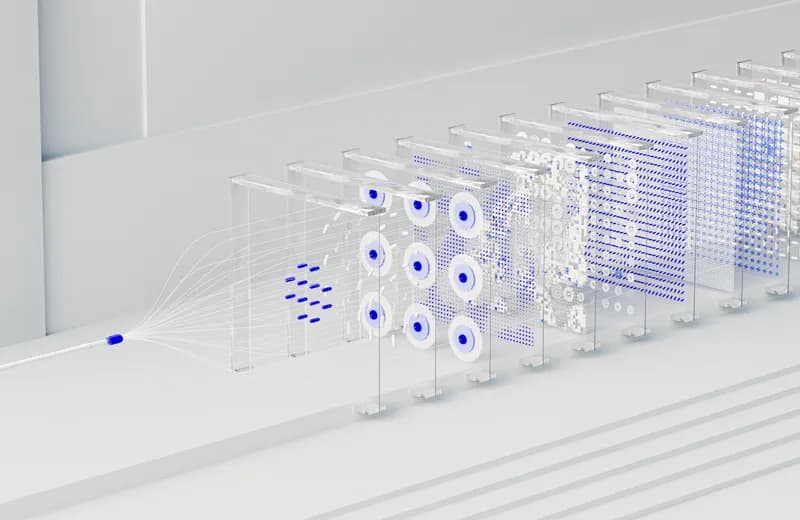
Memory & Context
Agents that retain conversation history, business context, and past decisions so responses stay accurate over time.

Evaluation & QA
Every agent is tested against realistic business scenarios, edge cases, and failure simulations before deployment.

Human Approval
Approval checkpoints for business-critical workflows that let your team review, edit, or approve actions before completion.

Monitoring
Continuous monitoring of production agents to catch performance issues, reduce operating costs, and improve response quality.
Our AI Agent Development Process
Building reliable AI requires more than connecting a language model to your software. Every engagement follows a structured engineering process that minimizes risk and delivers production-ready systems.
Discovery & Solution Design
We begin by understanding your business goals, existing workflows, software stack, and operational challenges, then define where AI creates real, measurable value before development begins.
Architecture & Planning
Our engineers design the agent's reasoning flow, integrations, memory strategy, permissions, and decision logic, with failure scenarios mapped early so reliability is built in from the start.
Development & Integration
We build your AI agent, connect it to your business systems, implement security controls, and integrate the workflows required for real operations, testing every feature as we go, not just at the end.
Testing & Validation
Before launch, we validate every critical workflow using real-world scenarios: accuracy, reliability, security, performance, and failure recovery. Only a consistently performing agent moves to production.
Production Deployment
Your AI agent is deployed into your live environment with monitoring, logging, analytics, and operational safeguards already in place. Our team supports rollout, training, and user adoption from day one.
Ongoing Support & Optimization
Launch isn't the finish line. We continue to monitor performance, update models, optimize prompts, and improve workflows as your business evolves, keeping your agent reliable long after deployment.
Production-Ready From Day One.
Unlike experimental AI prototypes, every solution we build is designed for long-term business use with security, observability, scalability, and maintainability built into the foundation. That's the difference between an AI demo and an AI system your business can depend on.
We needed a fraud detection agent that could not only act in real time but explain its reasoning to our compliance team. Their team built exactly that. Transparent, auditable, fast, and production-ready from day one.
Marcus Webb · Head of Risk, Greenfield Financial
Shipped And Running In Production.
Agentic AI Research Platform For Scientists And PhD Researchers
We built DARE — an agentic AI platform that lets researchers without engineering backgrounds build, run, and share sophisticated AI workflows on their own infrastructure. Now deployed at Carnegie Mellon University.

AI-Powered Sales Automation Platform For Meeting Intelligence And CRM Automation
We built SalesEdgeAI as the sole technology partner — an invisible AI layer that listens to sales calls, updates CRMs automatically, and drafts follow-ups, recovering 8–10 hours per rep per week.
Automated Inventory Management Solution For Automotive Parts Supply
We built HG Garage — an automated inventory management platform that synchronizes stock across multiple marketplaces and gives automotive parts suppliers a unified view of their business performance.
Frequently Asked Questions
Related AI Services
Looking for a broader AI solution? We also help businesses build intelligent systems beyond standalone AI agents.
Multi-Agent Systems
Coordinate multiple AI agents that collaborate to complete complex workflows, share context, and divide responsibilities across specialized tasks.
Explore Multi-Agent SystemsAI Workflow Automation
Automate repetitive business processes by combining AI with your existing software, APIs, and internal tools to create faster, more reliable operations.
Explore AI Workflow AutomationAI Development Services
From model selection and fine-tuning to custom AI applications and intelligent software, we help businesses build AI solutions tailored to their goals.
Explore AI Development ServicesVoice AI & Calling Systems
Deploy conversational voice agents that answer calls, qualify leads, schedule appointments, and integrate with your existing business systems.
Explore Voice AI SolutionsReady To Build An AI Agent For Your Business?
Replacing manual processes or automating complex workflows, our senior engineering team manages every stage from strategy to deployment, so your AI agent is reliable, secure, and built for long-term success.
- A free consultation to understand your business goals
- Recommendations tailored to your workflows and systems
- A clear roadmap with timeline and estimated investment
- Guidance from senior AI engineers rather than salespeople