Backend Development Services For Products That Can't Fail
Evolve Edge delivers backend development services for products where lost orders, wrong data, or slow pages cost real money. Our senior engineers build the servers, databases, and integrations behind your product in Python and Node.js, ready for growth and AI.
- Backends shipped
- 40+
- API uptime
- 99.95%
- Weeks typical timeline
- 4–16
- Engineers only
- Senior
What Is Backend Development?
Backend development is the work of building the server side of an application. It covers the logic, data, and connections that users never see but rely on every time they click, sign in, pay, or search inside your product.
- 01
Server
Receives every request from your app and sends back the right response in time.
- 02
Application Logic
The business rules that decide what happens, from pricing to permissions to approvals.
- 03
Database
Where your information is stored, organized, and protected so it stays complete and correct.
What A Strong Backend Does For Your Business
Customers never see your backend, but they feel it on every visit. A well-built one delivers four things your business depends on every day.
Data You Can Trust
Records stay accurate even when hundreds of people update the same information at the same moment.
Nothing Gets Lost
Payments, orders, and messages either finish completely or try again safely, so no transaction disappears halfway.
Speed Under Pressure
Pages respond quickly during launches, sales, and busy seasons, not only on quiet weekday mornings.
Faster Product Changes
A clean, well-organized backend lets your team add features in days instead of untangling old code first.
Our Backend Development Services
Every product needs a different mix of backend work. These are the six areas our senior engineers build, connect, and repair most often.
Custom Backend Development
New backends designed around your product's own data, rules, and users, rather than adapted from a generic template that fits nobody well.
Web And Mobile App Backends
One shared backend that serves your web app, iOS and Android apps, and partner systems with the same data and rules.
Integration Hubs
Stripe, Shopify, CRMs, and partner systems connected through one reliable layer that keeps records matched and flags any mismatch.
Background Processing And Data Pipelines
Billing runs, email sends, data imports, and scheduled reports that run on time and recover automatically if something fails.
AI Backends
The server-side systems that make AI features work, connecting models to your data, tools, and users safely and at a predictable cost.
Backend Audits And Rescue
Help for backends that crash, slow down, or block new features, starting with an independent review of what is going wrong.
Building public or partner APIs? See our API development services.
Scalable Backend Architecture From Day One
Scalable backend architecture is planned into the design, not added after the first outage. We start with a simple, well-organized system and split it into separate services only when growth makes it worthwhile.
For load testing and capacity planning, see Scalability Engineering. For speed tuning, see Performance Engineering.
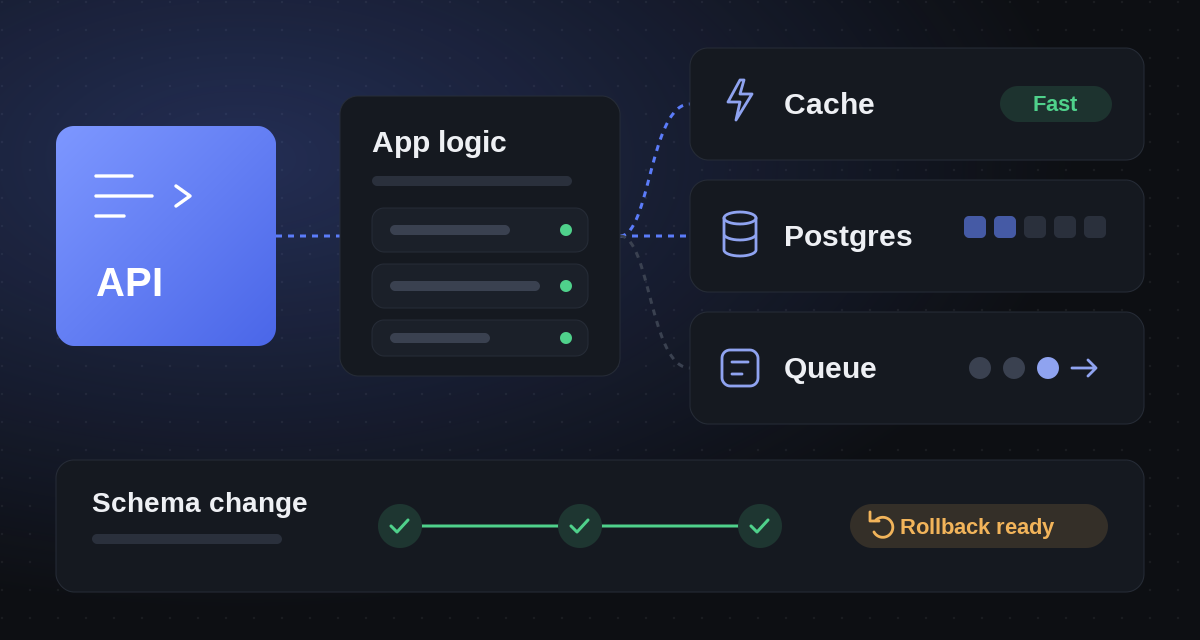
Data Built Around Real Use
The database is designed around how your product is actually used, so common requests stay fast as data grows.
Background Queues
Slow work like file processing and email runs in the background, so users never wait for it to finish.
Smart Caching
Information that people read often is kept ready in fast memory, taking pressure off the main database.
Database Changes Without Downtime
Structure changes roll out in safe, rehearsed steps while the product keeps running, with a rollback plan ready.
AI Backend Development For Production AI Features
AI changes what a backend has to handle. Model calls are slower than normal requests, cost money every time, and sometimes return wrong answers. AI backend development plans for all three from the start.
Model Gateway
One layer manages every AI provider, switching to a backup during outages and capping spending per feature.
Retrieval Pipelines
Company documents are cleaned, indexed, and searched so each AI answer is built from the right source material.
Long-Running AI Workflows
Multi-step AI tasks save their progress as they go, so a timeout or failure never forces a full restart.
Output Validation
Every AI response is checked against expected formats and rules before it reaches users or your database.
For AI search over company knowledge, see RAG systems. For AI that takes actions, see AI agent development.
Python And Node.js Backend Development
We build in two proven languages and choose between them based on your product, your team, and the work your backend will do most.
Python
Our choice for data-heavy and AI-focused products. Python backends built with FastAPI or Django handle processing, analytics, and machine learning work especially well.
Node.js And TypeScript
Our choice for web-first and real-time products. Node.js backend development in TypeScript shares code and data types with your frontend, which cuts bugs between layers.
Databases
Postgres is our default for most products. We add ClickHouse for analytics, DynamoDB or Elasticsearch when the workload needs them, and Redis for caching.
Should You Fix Or Rebuild Your Backend?
A rebuild is expensive and risky, so our default is to fix first. Rebuilding makes sense only when fixing the current system would cost more over time.
| Fix It When | Rebuild It When |
|---|---|
| Slowdowns come from a few heavy queries | Every new feature breaks something else |
| The data model still fits the product | The data model no longer matches the business |
| Your team understands the code | Nobody can safely change the code |
| Problems appear only at peak load | The technology is unsupported or insecure |
Not sure which side you are on?
A backend audit gives you a written report of what is working, the biggest risks, and recommended fixes ranked by business impact.
Our Backend Development Process
Most backend projects take 4 to 16 weeks. Each phase ends with working software your team can review, not just documents.
- 1Week 1
Architecture And Data Model
We map how your data connects, how it will be used, and what could fail before any code is written.
- 2Weeks 2–6
Core Services
Business logic, the database, sign-in, and the first background tasks are built and running in a test environment.
- 3Weeks 6–12
Integrations And Hardening
Partner connections, traffic limits, and load tests are completed, so the backend is proven before real users arrive.
- 4Weeks 12+
Operate And Hand Over
Live dashboards, alerts, runbooks, and pairing sessions prepare your engineers to run and grow the backend themselves.
Ways To Work With Our Backend Team
Choose the model that fits your roadmap, your budget process, and how much of the work you want to own.
Delivered Project
A fixed scope, clear milestones, and an agreed estimate. Best when you know what needs building and want one team accountable for delivering it.
Embedded Backend Engineers
Senior backend engineers join your standups and work in your codebase for at least 90 days, then hand over with full documentation.
Ongoing Operations
On-call support, incident response, and capacity planning after launch, so a senior team is ready whenever production needs attention.
Backends We've Built
As a backend development company, we prove our work in production. These four products run on backends we designed and built.
HG Garage
Inventory for auto parts suppliers kept in sync across several online marketplaces, with the true profit of every sale tracked automatically.
Axirify
A multi-tenant platform where every client company's data stays separate, combining property management, CRM, and project tracking in one system.

Zinng AI
One backend that handles calls, texts, and messages for small businesses around the clock, feeding everything into a single shared team inbox.

SalesEdgeAI
A Python and Django backend that connects calendars, email, and CRMs, updating sales records from every call with no manual entry.
How To Choose A Backend Development Company
Backend mistakes stay hidden until they become expensive. Check for these five things before you sign.
Partner checklist
- Production experienceBackends they built and still help run.
- A data safety planHow they protect records during every change.
- Honest adviceA willingness to recommend fixing over a costly rebuild.
- Real referencesClients at a similar scale or in your industry.
- Clean handoverDocumentation your own team can actually use.
What Affects Backend Development Cost
Every backend is estimated after a scoping call, because similar products can need very different work. These six factors shape your estimate the most.
Integrations
Each connected system adds mapping, testing, and handling for when it fails.
Data Volume And Migration
Moving and cleaning existing records adds careful, step-by-step verification work.
Traffic And Uptime Targets
Higher traffic and stricter uptime goals need more redundancy and testing.
AI Features
AI adds retrieval, validation, and ongoing model usage costs to the build.
Compliance Needs
Rules like HIPAA or SOC 2 add security controls and audit preparation.
New Build Or Repair
Fixing a current backend often costs less than building a new one.
Book a scoping call to receive an estimate based on your real requirements.
Book A Scoping CallFrequently Asked Questions
What engineering and product leaders ask before handing us their backend.
How do your backend development services start?
With a short scoping call, followed by a review of your current system or requirements. You then receive a written plan covering the recommended approach, timeline, and estimate before any work is signed.
Can you connect our backend to an ERP or legacy system?
Yes. We have connected products to SAP, Workday, Salesforce, and older internal systems, using modern APIs where they exist and file or database bridges where they do not.
Which cloud providers do you work with?
AWS is our default, and we also build on Google Cloud and Azure. If your company already has a cloud account and standards, we deploy into your environment and follow them. See our Cloud & DevOps service
How do you keep the backend secure?
Access is limited by role, data is encrypted in storage and in transit, secret keys live in a vault rather than in code, and third-party libraries are scanned on every change.
Can you meet compliance requirements like HIPAA or SOC 2?
Yes. We build the required controls, such as audit logs, access reviews, and encryption, into the backend from the start. For full audit preparation, our Compliance Pack covers policies and evidence. See the Compliance Pack
Who owns the code and data?
You do. The code, data, documentation, and cloud accounts belong to your company from day one. There is no licensing fee or lock-in, so any future team can continue the work.
Can you build the frontend too?
Yes. Our full stack team can build the web or mobile app on top of the backend, so one team owns the whole product and changes never wait on a second vendor. See our full stack development services
How do you keep us updated during the project?
You get a shared Slack channel with the engineers on your project, short written progress updates, and direct access to a senior lead who raises risks before they become delays.
Build A Backend Your Product Can Rely On
Our backend development services start with a free 30-minute scoping call. A senior engineer, not a salesperson, reviews your system and replies within one business day with a clear next step.
You own the code, data, and cloud accounts from day one. No lock-in.