Cloud Infrastructure Services That Pass Audits And Survive Outages
Evolve Edge delivers cloud infrastructure services for teams that need a foundation they can trust. We design and build secure accounts, networks, and data layers in code on AWS, Google Cloud, and Azure, so your platform passes security reviews, recovers from failures, and grows without surprises.
- Infrastructure stacks in production
- 45+
- Uptime target achieved
- 99.99%
- Weeks typical timeline
- 4–16
- Defined in code
- 100%
What Are Cloud Infrastructure Services?
Cloud infrastructure services design, build, and maintain the foundation your software runs on. That foundation has four building blocks: compute that runs your code, networking that connects it safely, data and storage that keep information, and identity and access that control who can do what. It can live in a public cloud, a private one, or a hybrid of both.
Compute
Runs your code.
Networking
Connects it safely.
Data And Storage
Keeps your information.
Identity And Access
Controls who can do what.
Signs Your Cloud Foundation Needs Work
Weak foundations rarely fail all at once. They show up as small warning signs that grow riskier every month.
Everything In One Account
Production, testing, and experiments share one space, so a mistake anywhere can reach customers.
Changes Made By Clicking
Settings live in a cloud console, not in reviewed code, and nobody can retrace them.
Security Questionnaires Stall
Enterprise buyers ask about controls and evidence that your team cannot show them.
Backups Never Tested
Backups exist, but nobody knows whether they work or how long recovery would take.
One Region, One Failure
Everything runs in a single location, so one regional outage could stop the product.
Nobody Knows What's Running
Forgotten servers and databases keep running with unclear owners and unknown purpose.
Our Cloud Infrastructure Services
Six services cover every layer of your cloud foundation. Each is explained in more detail below.
Cloud Architecture Design
A blueprint shaped around how your product works and grows.
Landing Zones
A secure, organized starting setup for every cloud account you run.
Infrastructure As Code
Every server, network, and setting defined in code your team reviews.
Disaster Recovery
Clear recovery targets, tested regularly, so outages never become disasters.
High Availability
Systems spread across locations so one failure never stops your product.
Compliance-Ready Architecture
SOC 2, HIPAA, and PCI requirements designed into the foundation itself.
Looking for cloud migration, cost optimization, Kubernetes, or managed cloud services? Those live on our Cloud and DevOps services page.
Cloud Architecture Design Built Around Your Product
Good cloud architecture design starts with your product, not a template. We shape it around how your software works, how fast it grows, and the rules it must follow.
Databases, caches, and message queues are sized for your real workloads, with backups and failover designed in from the very first day.
Security
Every layer designed so a single mistake cannot expose customer data or systems.
Reliability
Parts kept separate, so one broken component never drags the rest down with it.
Performance
The right compute, storage, and caching chosen for each workload, not one size for all.
Operability
A design your team can understand, monitor, and change without calling us.
AWS Landing Zone Setup, Explained Simply
An AWS landing zone is the secure, organized starting setup for all your cloud accounts. Instead of building safety into each project by hand, every new project starts safe automatically. We build the same foundation for Google Cloud and Azure.
Separate Accounts
Production, testing, and security each live in their own account.
Central Sign-In
One place to manage who can access which accounts.
Account Guardrails
Organization-wide rules that make risky settings impossible to switch on.
Central Logging
Every action recorded in one protected place nobody can edit.
Network Baseline
Private networks by default, with tightly controlled internet access.
Billing Separation
Costs traced clearly to each team, product, and environment.
Infrastructure As Code Services And Terraform Consulting
Infrastructure as code means every server, network, and setting is written as reviewed code instead of clicked into a console. Our infrastructure as code services and Terraform consulting cover new builds, existing setups, and codebases that have drifted out of shape.
New Foundations In Code
Environments built from Terraform from the very first day.
Importing Existing Setups
Click-built resources brought into code without rebuilding or downtime.
Reusable Modules
Shared building blocks, so teams stop copying the same code.
Policy As Code
Automatic checks that reject insecure or costly changes before they apply.
Drift Detection
Alerts whenever live infrastructure stops matching the approved code.
Terraform Cleanup
Messy or outdated Terraform codebases restructured safely, step by step.
To run infrastructure changes through automated release pipelines, see our DevOps consulting services.
Cloud Disaster Recovery With Tested, Measurable Targets
Cloud disaster recovery starts with two business decisions.
- Recovery time (RTO)
- How long you can afford to be offline.
- Recovery point (RPO)
- How much recent data you can afford to lose.
Those two answers decide which approach fits.
| Approach | How It Works | Recovery Time | Relative Cost |
|---|---|---|---|
| Backup and restore | Rebuild from backups after a failure | Hours | Lowest |
| Pilot light | Core systems kept ready, the rest started on demand | Tens of minutes | Low |
| Warm standby | A smaller copy always running | Minutes | Medium |
| Active-active | Full copies running in two places | Near zero | Highest |
Recovery is rehearsed on a schedule and documented step by step. Returning to normal operations after a failure is planned just as carefully.
High Availability Across Zones And Regions
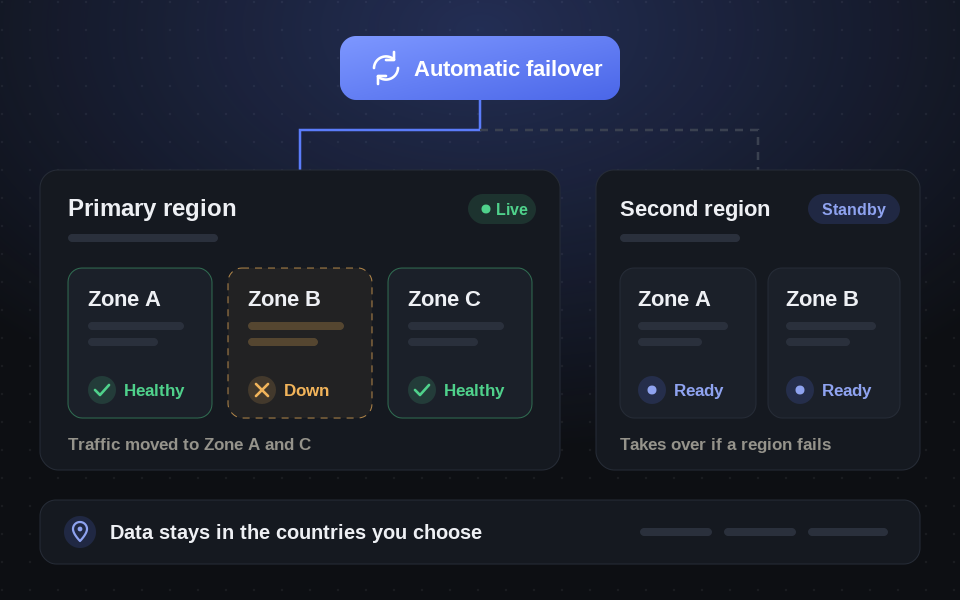
High availability keeps your product online while individual parts fail. It works at four levels, chosen to match what downtime would cost you.
Multiple Zones
Systems spread across separate data centers within one region, so one can fail safely.
Multiple Regions
A second region stands ready to take over if an entire region goes down.
Automatic Failover
Traffic moves away from failed components on its own, with no manual steps needed.
Data Residency
Data stays in the countries that your customers, contracts, and regulators require.
Compliance-Ready Cloud Architecture
Regulated products need more than good intentions. We design SOC 2, HIPAA, and PCI requirements directly into your accounts, networks, and data storage. Encryption is on everywhere, access is reviewed regularly, and evidence is collected automatically, so auditors and enterprise buyers can check it quickly. For deeper controls, see Security Engineering and our Compliance Pack.
Start With A Cloud Architecture Review
A cloud architecture review is a short, fixed-scope look at your current setup. Over one to two weeks, we assess security, reliability, performance, and how easily your team can operate it, then hand you four clear outputs.
Risk Summary
The biggest weaknesses in your setup, explained in plain business language.
Ranked Fixes
Every issue sorted by risk and effort, so the most important come first.
Quick Wins
Low-effort changes you can make this month to reduce risk immediately.
Roadmap
A step-by-step plan from where you are today to a solid foundation.
How We Build Your Cloud Foundation
Most foundation projects run 4 to 16 weeks. Your team stays involved and informed at every stage.
- 1Weeks 1–2
Discover And Design
We document what exists today and agree the target architecture with your team.
- 2Weeks 2–8
Build
Accounts, networks, access, and the data layer are built in code and reviewed in stages.
- 3Weeks 8–12
Validate
Load tests and an independent security check prove the foundation before real traffic arrives.
- 4Weeks 12+
Hand Over
Documentation, training, and full ownership pass to your team, with support while they settle in.
Cloud Platforms And Tools We Work With
Our engineers work across all three major clouds and the tools that manage them.
Cloud Providers
Infrastructure As Code
Landing Zones
Data
Backup And Recovery
Ways To Work With Our Infrastructure Team
Begin with a review, or hand us the full build. Choose the model that fits.
Architecture Review
The lowest-risk starting point, with a fixed scope and no ongoing commitment.
Foundation Project
A defined build with agreed milestones, a clear estimate, and full handover.
Embedded Engineers
Senior platform engineers working inside your team for at least 90 days.
Ongoing Support
Day-to-day operations after launch through our managed cloud services.
How To Choose A Cloud Infrastructure Partner
Before trusting someone with your foundation, ask for these five things.
Partner checklist
- Real code samplesInfrastructure code from past work, not slides.
- Recovery proofWhen they last ran a recovery drill, and how long it took.
- Provider-neutral adviceRecommendations based on your needs, not partner incentives.
- Senior engineersExperienced people doing the hands-on work.
- A clear handoverDocumentation and training your team can actually use.
What Affects Cloud Infrastructure Cost
Every engagement is estimated after a scoping call. These six factors shape your estimate more than anything else.
Accounts And Environments
More accounts and environments mean more setup and review.
Regions And Availability
Higher availability targets need more locations and more testing.
Recovery Targets
Faster recovery and less data loss need more standby infrastructure.
Compliance Needs
SOC 2, HIPAA, or PCI add controls, reviews, and evidence.
Existing Setup
Large click-built environments take longer to bring into code.
Type Of Engagement
Reviews and projects get fixed estimates; ongoing work uses monthly rates.
Book a scoping call to receive an estimate based on your actual setup.
Book A Scoping CallFrequently Asked Questions
What engineering leaders ask before trusting us with their cloud foundation.
How do your cloud infrastructure services start?
With a short scoping call. If your current setup is unclear, we usually begin with an architecture review. If the needs are clear, we move straight to design and build.
AWS, Google Cloud, or Azure?
We are provider-neutral and build on all three. Our recommendation depends on your existing commitments, compliance needs, credits, and the skills your team already has.
Should we use AWS Control Tower or a custom landing zone?
Control Tower is faster to set up and suits most growing companies. A custom landing zone in Terraform gives more control for strict rules or unusual account structures.
Can you work in our existing accounts?
Yes. We use limited-access roles inside your accounts and record every change in code, so you always see exactly what was done and why.
Terraform or another tool?
Terraform is our default because it works across every major cloud. If your team already uses CloudFormation, CDK, or Pulumi, we build with that instead.
How often should disaster recovery be tested?
At least twice a year, and after any major change to your systems. Untested recovery plans tend to fail exactly when they are needed most.
Do we need more than one region?
Not always. It depends on what an hour of downtime costs you and what you have promised customers. Many products only need multiple zones within one region.
Who owns the infrastructure and code?
You do. All cloud accounts, code, and documentation belong to your company from day one, so your team or any future partner can continue the work.
Build A Cloud Foundation You Never Have To Worry About
Our cloud infrastructure services start with a free 30-minute scoping call. A senior engineer, not a salesperson, reviews your setup and replies within one business day with a clear next step.
You own every cloud account, line of code, and document from day one.