API Development Services Your Partners And Products Can Rely On
Evolve Edge delivers API development services that connect your product to partners, customers, mobile apps, and AI agents. Our senior engineers design, build, and document REST, GraphQL, and gRPC APIs, and integrate the third-party platforms your business already depends on.
- Public APIs shipped
- 25+
- Breaking changes at 12 months
- 0
- Documented
- 100%
- Weeks typical timeline
- 3–12
What Are API Development Services?
API development services cover designing, building, securing, documenting, and maintaining the interfaces that let software systems share data and actions. Think of an API as a restaurant menu for your product: it tells other systems exactly what they can request, what to provide, and what they will get back.
Your product's API menu
What A Well-Built API Does For Your Business
A good API is more than a technical asset. It shortens sales cycles, opens new channels, and speeds up your own teams.
Partners Integrate Faster
Clear, predictable APIs cut partner onboarding from months of back-and-forth to a few days of focused work.
Enterprise Deals Move Forward
When a buyer asks whether you have an API, the answer stops being the reason a contract stalls.
New Revenue Channels
Integrations and app marketplaces put your product in front of customers who already use your partners' tools.
Faster Internal Teams
Web, mobile, and internal tools draw from one reliable source, so every team builds on the same data.
Our API Development Services
Some APIs open your product to the world, while others connect it to the tools you rely on. We design, build, and maintain both.
Custom API Development
New APIs designed around your product's data and the people who will use them, planned before a single endpoint is built.
Public And Partner APIs
APIs other companies build their products on, with self-service keys, usage plans, and a smooth path from signup to first call.
Internal APIs For Web And Mobile
One shared API that powers your web app, iOS and Android apps, and internal tools, so features ship everywhere at once.
Third-Party API Integration
Your product connected to payment, CRM, ERP, and industry platforms, so information moves between systems without anyone re-entering it by hand.
API Modernization
Older APIs, including SOAP services, upgraded to modern standards in stages, without breaking the apps and partners that use them today.
API Gateways And Management
Gateways such as Kong or AWS API Gateway set up to handle keys, usage tracking, and traffic routing in one central place.
Need the server-side systems behind your APIs? See our backend development services.
API Integration Services For The Platforms You Already Use
Third-party API integration connects your product to the outside platforms your business runs on. Data moves automatically, records stay matched, and nobody spends their week copying information from one screen to another.
Payments
Stripe and other payment providers connected for checkout, subscriptions, refunds, and automatic payment status updates.
CRM And ERP
Salesforce, HubSpot, SAP, and Workday kept in sync with your product's customers, orders, and records.
E-commerce And Marketplaces
Shopify stores and online marketplaces linked for products, stock levels, orders, and fulfilment updates.
Communication And Calendars
Email, calendar, and meeting tools connected so messages, bookings, and call notes land in the right place.
Healthcare Systems
Epic and other EHRs connected for scheduling, intake, and records, with patient data protected at every step.
Finance And Banking
Core banking platforms such as FIS, Jack Henry, and Temenos linked to modern apps for balances and transactions.
Every integration retries automatically when a provider goes down and runs regular checks that confirm both systems hold matching records. For connecting AI model providers, see LLM integrations.
REST API Development vs GraphQL API Development vs gRPC
Each API style suits a different job. Choosing the right one early saves months of rework and keeps everyone who uses your API productive.
| REST | GraphQL | gRPC | |
|---|---|---|---|
| Best for | Public and partner APIs | Your own web and mobile apps | Fast internal service-to-service calls |
| How data is requested | Fixed endpoints | Client asks for exactly what it needs | Strict, typed contracts |
| Caching | Simple | Needs extra setup | Limited |
| Versioning | Explicit versions | Evolves without versions | Versioned contracts |
| Learning curve | Low | Medium | Higher |
We recommend a style based on who will call your API and how. Many products use REST for partners and GraphQL for their own apps.
APIs Built For Apps, Partners, And AI Agents
AI agents and copilots increasingly act on products through their APIs, booking, updating, and buying on a person's behalf. An API that agents can use reliably becomes a new way for customers to reach you.
To build the agents themselves, see AI agent development.
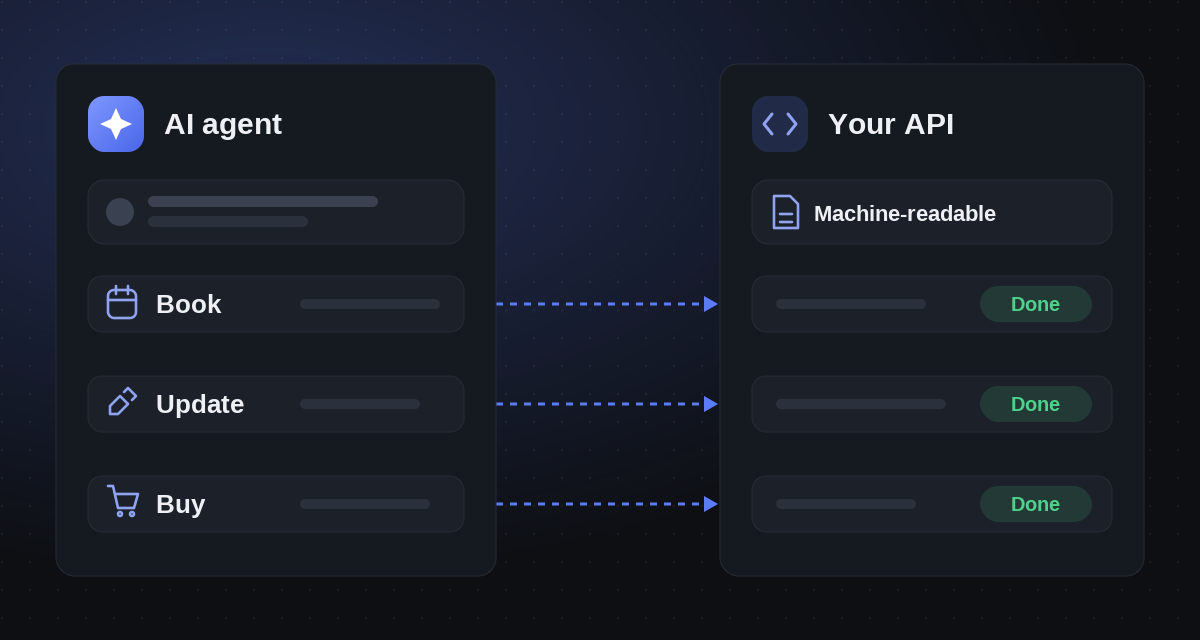
Machine-Readable Descriptions
Every action is described in a standard format that AI agents can read, understand, and call without guessing.
Clear Actions And Inputs
Consistent names and simple inputs make each action obvious, so agents choose the right one the first time.
Predictable Errors
Error messages explain what went wrong and how to fix it, so an agent can recover on its own.
Safe Repeat Requests
Sending the same request twice never charges a card twice or creates duplicate orders, even when agents retry.
Secure APIs By Design
An API is a door into your business. These four protections make sure only the right callers get through.
For broader platform security and audits, see Security Engineering.
Access Control
Scoped keys and OAuth sign-in give each caller access to exactly what it needs and nothing more.
Abuse Protection
Rate limits and traffic monitoring stop scraping, misuse, and sudden surges before they affect other users.
Attack Protection
Every request is checked for the most common API attacks, from injected code to broken access rules.
Audit Trails
A permanent record of who called which endpoint and when, ready for security reviews and investigations.
APIs Developers Actually Want To Use
Adoption depends on how quickly a developer gets their first call working. These four details make that happen in minutes, not days.
Interactive Documentation
Every endpoint explained with examples and a live "try it" panel right in the browser.
Sandbox Environments
A safe test copy with sample data, so partners experiment without touching real records.
Ready-Made SDKs
Client libraries in TypeScript, Python, and Go, generated and tuned for the most common tasks.
Quickstart Guides
Step-by-step guides that take a new developer from signup to a working request quickly.
Our API Development Process
Most API projects take 3 to 12 weeks. The plan is agreed and tested with real users before the main build begins.
- 1Week 1
Contract Design
We draft the full API plan and review it with your team and one pilot partner before writing code.
- 2Weeks 2–5
Core Build
Access, main actions, events, and error messages are built and checked against the agreed plan at every step.
- 3Weeks 5–8
Docs And SDKs
Reference documentation, quickstart guides, and client libraries are written and tested against the sandbox environment.
- 4Weeks 8+
Partner Launch
Pilot partners go live first, their feedback shapes the final details, and wider access opens once the API proves itself.
Keeping Your API Stable For Years
Partners build their businesses on your API, so stability matters more than speed after launch. Four practices keep it dependable.
- 01
Breaking-Change Checks
Automated tests compare every release against the published contract and block changes that would break existing users.
- 02
Versioning And Notice
A published versioning policy and months of advance notice before any feature is retired or replaced.
- 03
Uptime And Error Monitoring
Live monitoring tracks availability and error rates, alerting engineers the moment something starts going wrong.
- 04
Public Changelog
A clear record of every change that partners can follow, subscribe to, and plan around.
APIs And Integrations We've Built
As an API development company, we measure success by what partners and products build on our work. Here are three examples.

SalesEdgeAI
One unified API layer connecting calendars, email, meeting tools, and CRMs, so sales records update from every call without manual entry.
HG Garage
Marketplace integrations that keep auto parts inventory in sync across several online sales channels and track profit on every order.
Axirify
Third-party API integrations inside a single property management platform that replaced several disconnected tools for client teams.
How To Choose An API Development Company
The best API partners show their work openly. Check these five things before you commit.
Partner checklist
- Public docs you can readLive API documentation from past projects.
- Platform experienceIntegrations with the exact systems you need connected.
- Senior engineersThe people designing your API, not only selling it.
- References you can callPartners or clients who use their APIs.
- A written plan firstScope, approach, and estimate agreed before signing.
Ways To Work With Our API Team
Pick the model that fits your roadmap and how much of the work you want to own.
Delivered Project
A fixed scope, clear milestones, and an agreed estimate. Best when you know what the API must do and want it delivered.
Embedded Engineers
Senior API engineers join your standups and work in your codebase for at least 90 days, then hand over with full documentation.
Ongoing Support
A senior team on retainer for fixes, new endpoints, and partner questions, so your API keeps growing well after launch.
What Affects API Development Cost
Every API project is estimated after a scoping call, because similar goals can need very different work. These six factors shape your estimate most.
Endpoints And Actions
More actions mean more design, building, testing, and documentation work.
Number Of Integrations
Each connected platform adds mapping, testing, and failure handling.
Audience
Public APIs need more security, documentation, and support than internal ones.
Security And Compliance
Rules like HIPAA or PCI add controls, reviews, and audit preparation.
Documentation And SDKs
More SDK languages and deeper guides add writing and testing time.
New Build Or Modernization
Upgrading an existing API means extra care to protect current users.
Book a scoping call to receive an estimate based on your real requirements.
Book A Scoping CallFrequently Asked Questions
What product and engineering leaders ask before building or integrating an API.
How do your API development services start?
With a short scoping call, followed by a review of your existing systems and goals. You then receive a written plan with the recommended API style, timeline, and estimate before any work is signed.
Can you document an API that already exists?
Yes. We generate a standard specification directly from your code, fill in missing details, and add examples and a sandbox, so partners can start using it without asking your team for help.
Can you integrate a third-party API with poor documentation?
Yes. We test the API directly to learn how it really behaves, work with the vendor where possible, and wrap it in a protective layer that handles its quirks and outages.
What happens when a third-party provider changes its API?
We lock integrations to specific versions and watch for provider announcements and unexpected changes. When an update is needed, support plans cover making it before the old version is switched off.
Can you connect systems that don't have an API?
Yes. We build a custom API layer on top of older databases, file exports, or internal systems, giving modern apps a clean and secure way to reach that data.
Can your APIs meet HIPAA or PCI requirements?
Yes. We build the required controls, such as encryption, access limits, and complete audit logs, into the API from the start, and keep sensitive data out of logs and error messages.
How long does a single integration take?
Simple integrations with well-documented platforms often take one to three weeks. Complex or poorly documented systems are scoped individually after a short technical review of how they behave.
Who owns the API and its code?
You do. The code, documentation, specifications, and accounts belong to your company from day one, with no licensing fees or lock-in, so any future team can continue the work.
Build An API Your Partners Will Love
Our API development services start with a free 30-minute scoping call. A senior engineer, not a salesperson, reviews your project and replies within one business day with a clear next step.
You own the code, documentation, and specifications from day one. No lock-in.