Best Tech Stack for Startups Shipping AI Products
Learn the best AI tech stack for startups, from models and retrieval to orchestration and evaluation. Build faster, control costs, and scale without rewrites.
TLDR
Learn the best AI tech stack for startups, from models and retrieval to orchestration and evaluation. Build faster, control costs, and scale without rewrites.
- Keep the application layer conventional — Next.js, PostgreSQL, managed auth, and hosted model APIs — and save engineering effort for the intelligence layer.
- The intelligence layer (retrieval, orchestration, evaluation, cost control) is where AI products actually succeed or fail.
- Start lean: hosted APIs, pgvector, and direct API calls. Add routing, a dedicated vector database, or an orchestration framework only once traction demands it.
- Treat the stack as a migration path — the post-PMF version adds to the pre-PMF version, it doesn't replace it.
Most founders already carry a working blueprint for building software. Pick a proven framework, a relational database, a managed host, wire in auth and payments, and ship. That playbook still holds for the application layer. The problem is that an AI product is not a SaaS app with a model attached, and treating it that way is where the stack decision quietly goes wrong.
The real work is not choosing a model. That layer has commoditized to the point where picking a provider is closer to a routing detail than a defining one. What determines whether a product ships fast and scales cleanly lives in the layers around it, and those are the decisions worth getting right before a line of code gets written.
This guide breaks down that stack by stage, so the choices made at the start are the ones that grow with the product instead of the ones that have to be replaced.
What Makes an AI Product Stack Different From a Normal SaaS Stack
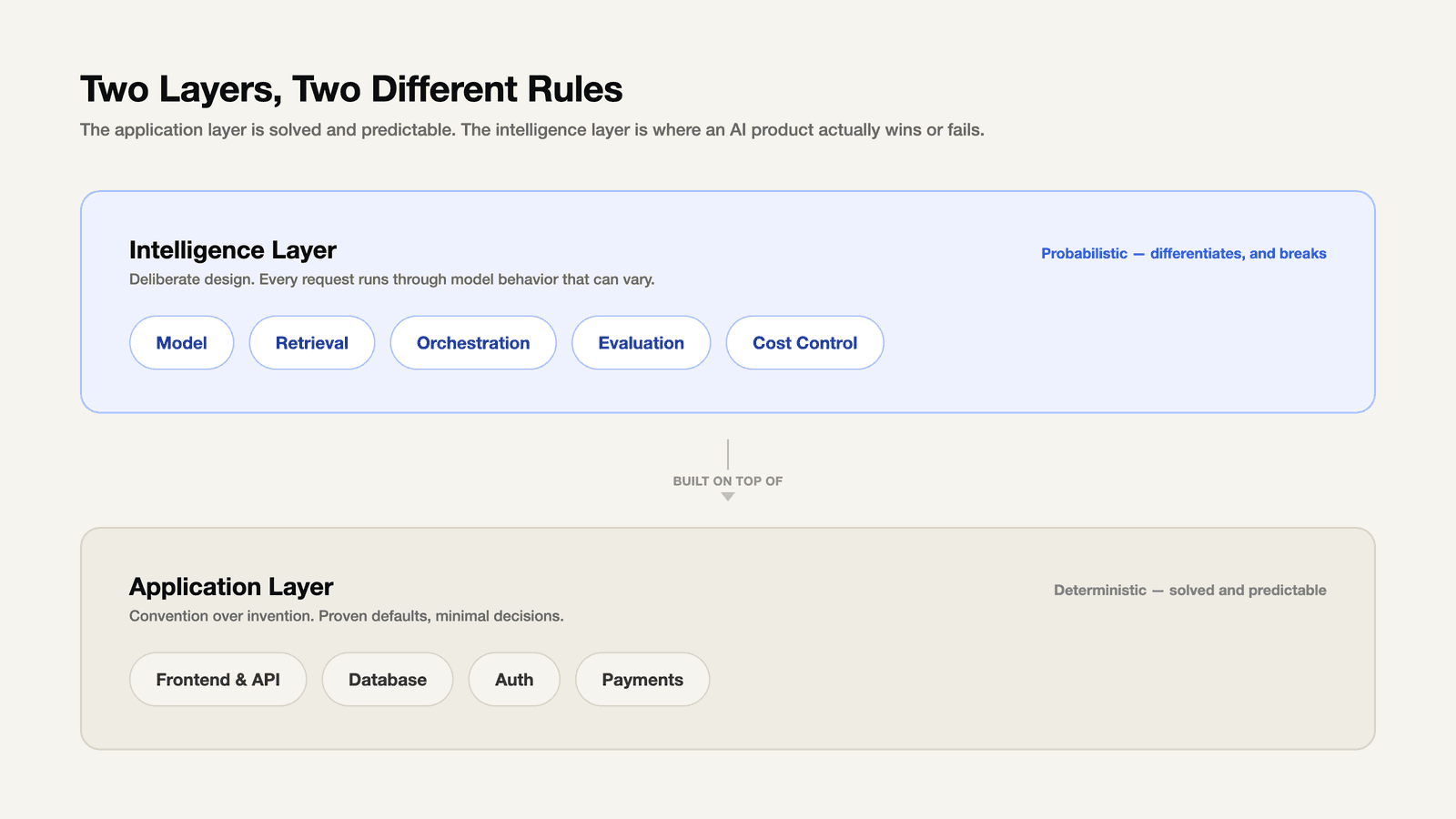
Conventional SaaS development is close to a solved problem, and that is a feature. The frontend renders, the API moves data, the database stores it, auth gates access, and payments collect revenue.
These layers converged on defaults for a reason. They are predictable, well documented, and staffed by a large hiring pool, which makes the smart move keeping them conventional and spending the invention budget elsewhere.
AI development inherits all of that and introduces a new layer on top. The moment a model drives part of the product, its behavior turns probabilistic, and that single shift creates five concerns the intelligence layer has to manage directly.
- Nondeterministic output means the same input can produce different responses, so the team manages correctness as a distribution across a range of inputs.
- Retrieval supplies the model with context beyond its training data, which makes retrieval quality a first-class determinant of output quality.
- Orchestration coordinates the multi-step flows and tool calls that run between request and response, connective tissue the team designs deliberately.
- Evaluation measures whether a model-driven feature still performs, since quality degrades quietly and surfaces late without it.
- A live cost model tracks inference spend as it scales with usage and shifts by model and call pattern, so the team observes and controls it continuously.
The app layer rewards convention. The intelligence layer rewards deliberate design, because it drives both what makes the product distinct and where it breaks under real use.
The App Layer
The application layer is the most settled part of an AI product, and that maturity is worth leaning on. The patterns are documented, the tradeoffs are understood, and the market has converged on strong defaults. Adopting them frees the team to concentrate on the intelligence layer, where the product differentiates and where the real risk sits.
Frontend and API
Next.js with React remains the default for most web products. It offers server-side rendering for SEO, a large hiring pool, and a deployment path from repository to production in an afternoon. The AI-specific consideration is how responses reach the user.
Model output arrives token by token, so a product that waits for the full response before rendering feels slow even when the model is fast. Streaming the response as it generates keeps the interface responsive. A streaming-capable UI layer, through the framework's own primitives or a dedicated SDK, belongs in the initial build.
Database and Auth
PostgreSQL is the 2026 default for startup data. It handles relational workloads, scales further than most products will need, and extends into adjacent jobs the AI layer will later ask of it. Auth deserves the same restraint.
A managed authentication provider covers sign-in, session handling, and the security edge cases that consume weeks when built in-house. A custom identity system rarely pays off for an early product.
Proven choices win here because their failure modes are known and already solved, while a novel option trades a real hiring pool and mature tooling for risk the product gains little from taking on.
Payments and the Rest of the Plumbing
Payments follow the same logic. A managed provider handles billing, tax, and compliance that would otherwise pull an engineer off the core product for weeks. The remaining plumbing, logging, background jobs, transactional email, has settled defaults worth adopting directly. Choose the standard option, wire it in, and keep moving.
Each decision rewards convention over invention. Engineering time spent on a clever application layer is time taken from the layer that carries the product's risk and its differentiation.
Treat the Model Layer as a Commodity
1. Begin With Proprietary APIs
Start with a hosted API from OpenAI, Anthropic, or Google. These providers deliver frontier capability behind a single call, absorb the operational burden of serving models at scale, and let a team validate whether the product works before committing to any infrastructure.
Custom models, fine-tuning, and self-hosting introduce cost and complexity that a pre-validation product cannot justify. Prove the product with an API first, and treat a more specialized build as a later question that becomes real once the API approach shows a concrete limit.
2. Control Cost Through Routing and Caching
Model choice can follow the difficulty of the task. Simple classification, extraction, and formatting run well on smaller, cheaper models, while harder reasoning justifies a frontier call. Routing each request to the appropriate model keeps quality high on demanding work and holds spend down on the routine majority.
Caching adds a second layer of control by returning stored responses for repeated or near-identical inputs, which avoids paying twice for the same generation. Both patterns are worth building in early, because inference cost compounds with usage and a routing discipline established at low volume scales cleanly as traffic grows.
A deeper treatment of these tradeoffs sits in our guide to LLM cost optimization strategies, which covers routing and caching in more detail.
When Self-Hosting or Open Weights Earns Its Place
Open weights and self-hosted models have a real role, and it tends to arrive later for specific reasons. Three pressures typically justify the move.
- Cost is the most common trigger, when call volume grows high enough that per-token API pricing exceeds the cost of running a model directly.
- Latency is the second, when a product needs response times tighter than a hosted API reliably delivers.
- Data residency is the third, when regulatory or contractual requirements demand that data stay inside a controlled environment.
Under one of these pressures, self-hosting justifies its operational weight. In their absence, the hosted API remains the better economic choice, and the move to self-hosting fits the moment the product crosses a threshold the API cannot clear.
Retrieval, Where Most AI Bugs Actually Live
The model usually takes the blame when an AI product returns a confidently wrong answer. The cause more often sits upstream in retrieval. A model can only reason over the context it receives, so when that context is missing, stale, or loosely matched to the question, the output degrades regardless of how capable the model is.
Treating retrieval as a first-class part of the stack is what separates a reliable product from one that guesses well in the demo and fails in the field.
Hallucination Is Usually a Retrieval Failure
The instinct when a model hallucinates is to reach for a larger or newer one. That rarely fixes it. If the retrieval step pulls the wrong passage, an outdated document, or nothing relevant, the model fills the gap with a plausible guess. Diagnosing these hallucinations starts with inspecting what got retrieved for a given query, because the evidence trail almost always points back to retrieval before it points at the model.
Start With pgvector
For most early products, a dedicated vector database is overhead the product does not yet need. PostgreSQL with the pgvector extension stores embeddings inside the same database that already holds the application's data, which means one system to run, one backup to manage, and one connection pool to reason about.
It handles recall and latency well at the scale most startups operate at. A separate vector database earns its place once the corpus grows into the millions of vectors and recall or latency starts to slip on the specific workload.
Reaching for Pinecone, Weaviate, or Qdrant before then adds a moving part without a matching return, and the threshold worth trusting is a benchmark on real data rather than a precautionary default.
What Actually Determines Retrieval Quality
Founders tend to fixate on which embedding model to use, and that choice matters far less than the work around it. Retrieval quality is decided mostly by how the source material gets prepared and maintained.
- Chunking determines whether a retrieved passage carries enough context to be useful or arrives fragmented and stripped of meaning.
- Freshness determines whether the system retrieves current information or serves answers from documents that have since changed.
- Metadata determines whether the system can filter and rank by attributes like source, date, or access level rather than matching on raw text alone.
Get these right and a mid-tier embedding model performs well. Get them wrong and the strongest embedding model on the market still retrieves the wrong evidence. The embedding choice is a tuning decision that comes after the preparation work, and treating it as the primary lever is where retrieval effort gets misspent.
The deeper architecture of retrieval-augmented generation, including reranking, hybrid search, and advanced chunking strategies, belongs to the RAG pillar, which this section links to rather than duplicates.
Orchestration, When You Need It and When You Don't
Orchestration frameworks promise to manage the complexity of multi-step AI workflows, and that promise leads many teams to adopt one before they have complexity to manage. The added surface area carries a cost.
Every framework is another dependency, another abstraction to debug through, and another set of assumptions baked in early. The discipline worth holding is to add orchestration when the work requires it and keep the first version as direct as the problem allows.
Start With Direct API Calls
A direct call to a model API is the simplest thing that can work, and for many features it is all the product needs. Before reaching for a framework, it helps to question whether the step needs a model at all, since a rule, a regex, or a database query often solves the problem faster and more predictably than an inference call. When a model is warranted, a plain API call keeps the path legible, and starting there means the team understands the workflow before an abstraction hides it.
The Threshold for Orchestration
Orchestration becomes worth its overhead when a single call stops being enough to do the job. A few patterns mark that point.
- Multi-step workflows, where the output of one call feeds the input of the next and the sequence needs coordination.
- Tool calls, where the model has to invoke external functions, query systems, or take actions rather than only return text.
- Agentic loops, where the system decides its own next step based on intermediate results rather than following a fixed path.
Above this threshold, hand-rolled glue code turns fragile faster than a framework would, and adopting one buys back the reliability a growing web of custom conditionals loses.
Structured Outputs as a Reliability Primitive
Much of the fragility in AI workflow automations comes from parsing free-form model text into something the rest of the system can act on. Structured outputs remove that fragility by constraining the model to a defined schema, so a downstream step receives predictable fields instead of prose it has to interpret.
This matters most where output flows into code, a query, or an action, since a malformed response there fails silently or propagates bad data. Enforcing a schema turns the model's output into a dependable interface and cuts the defensive glue code a workflow would otherwise carry.
The deeper architecture of multi-step and multi-agent systems, including coordination patterns, state management, and failure handling across agents, belongs to the multi-agent systems pillar, which this section points to rather than reproduces.
Evaluation and Observability
A model-driven feature clears a very different bar in production than in a demo, where inputs are clean and chosen. Evaluation that runs once before launch measures only that first condition, which is why quality problems tend to surface after release. Holding quality steady in production comes down to a few practices.
- Continuous evaluation, meaning a test set built from real cases, scored automatically on every change to prompts, models, or retrieval, with human review kept for the judgment calls scoring cannot make.
- Workflow-level observability, since logging the prompt and response explains little once a multi-step run misbehaves. Tracing needs retrieval timing, the exact context the model received, and step-by-step visibility into the run.
- Treating model output as untrusted input, validated and constrained before it drives any code, query, or downstream action.
A Stage-Aware Reference Stack
The right stack depends on where the product is, and the common mistake is building for a stage the company has not reached. A pre-product-market-fit team that stands up routing, a dedicated vector database, and a full observability platform spends its scarce time operating infrastructure instead of finding out whether anyone wants the product.
The stack below is designed as a migration path. The early version proves the product, and the later version adds to it rather than replacing it, so nothing built at the first stage gets thrown away at the second.
Pre-PMF: The Smallest Stack That Proves the Product
Before product-market fit, the goal is to learn whether the product works with the least infrastructure that can answer the question. That means a hosted model API rather than any custom or self-hosted model, pgvector inside the existing Postgres instead of a separate vector database, and direct API calls in place of an orchestration framework until the workflow genuinely needs coordination.
Evaluation at this stage stays lightweight, a small test set scored on changes, enough to catch obvious regressions without building a measurement program. The discipline is restraint. Every component added here is a component to maintain while the core question, does this product work, is still open.
Post-PMF: What You Add as You Scale
Once the product has traction, load and cost start to matter, and the stack grows to meet them. This is an additive step rather than a rebuild. Model routing gets introduced to send simple tasks to cheaper models and hard ones to frontier calls.
Observability deepens from basic logging into trajectory-level tracing. Lightweight evaluation matures into a continuous loop scored on every change. Cost controls move from an occasional check into real-time monitoring.
A dedicated vector database enters only once the corpus and workload cross the threshold where pgvector's recall or latency slips. Each addition responds to a pressure the product now actually feels, and each one sits on top of what the pre-PMF stack already established.
The table below maps the two stages by layer, showing what the early stack uses and what the scaling stack adds on top of it.
The application layer set up at the start carries through without change, and the intelligence layer grows by addition, so scaling is a matter of extending the stack rather than rewriting it.
| Layer | Pre-PMF | Post-PMF |
|---|---|---|
| Model | Hosted API, single provider | Routing across models by task, caching |
| Retrieval | pgvector in existing Postgres | Dedicated vector DB once volume warrants |
| Orchestration | Direct API calls | Framework for multi-step and tool-calling flows |
| Evaluation | Small test set, scored on changes | Continuous evals from real failures |
| Observability | Basic request and response logging | Trajectory-level tracing |
| Cost | Occasional review | Real-time monitoring and controls |
| App layer | Next.js, Postgres, managed auth and payments | Unchanged |
Frequently Asked Questions
What Is the Difference Between an AI Stack and a Normal Startup Stack?
A normal stack (frontend, API, database, auth, payments) behaves deterministically. An AI stack adds an intelligence layer that does not: probabilistic output, retrieval, orchestration, evaluation, and a cost model that moves with usage. The application layer stays the same. The difference lives in the layer above it.
Do I Need a Vector Database?
Most early products do not. Postgres with pgvector stores embeddings inside your existing database and handles recall and latency well at startup scale. A dedicated vector database earns its place once the corpus reaches millions of vectors and performance slips on your specific workload, and that call should rest on a benchmark rather than a default.
Should I Use an Orchestration Framework Like LangGraph?
Only once the work requires it. A direct API call is enough for many features. A framework earns its overhead when a single call stops doing the job, which shows up as multi-step flows, tool calls, or agentic loops. Below that point it adds structure the product does not use.
When Should I Self-Host Models Instead of Using APIs?
Start with a hosted API. Self-host only when a specific pressure justifies it: cost at high call volume, latency tighter than an API delivers, or data residency requirements. Absent one of these, the hosted API remains the better choice.
Why Do AI Products That Demo Well Fail in Production?
Demos run on clean, chosen inputs; production runs on whatever users send. Failures usually trace to the layers around the model, most often wrong retrieval, unchecked output, or no continuous evaluation to catch drift. Reliability also compounds across steps, so a chain of capable components can still fail more often than it succeeds.
Conclusion
Shipping an AI product comes down to timing as much as tool choice. The aim is to avoid infrastructure the product does not yet need while staying alert to the signals that it is time to add it. Read those signals reasonably well and the stack can move fast early and grow without a rewrite later. Build from where the product actually is, add each layer when it earns its place, and the stack ends up fitting the company rather than working against it.